

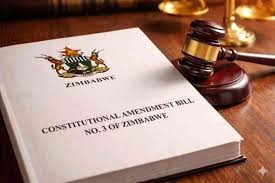









AG Mabhiza’s absurd attempt to circumvent a national referendum is a mockery of the Constitution
Source: AG Mabhiza’s absurd attempt to circumvent a national referendum is a mockery of the Constitution The things we do or say in order to deny the undeniable are amazing. Tendai Ruben Mbofana The Attorney General of Zimbabwe, Virgini...

AG Mabhiza’s absurd attempt to circumvent a national referendum is a mockery of the Constitution
Source: www.zimbabwesituation.com
Source: AG Mabhiza’s absurd attempt to circumvent a national referendum is a mockery of the Constitution The things we do or say in order to deny the undeniable are amazing. Tendai Ruben Mbofana The Attorney General of Zimbabwe, Virginia Mabhiza, has recently embarked on a perilous journey of legal revisionism that should alarm every citizen who believes in the sanctity of the supreme law. If you value my social justice advocacy and writing, please consider a financial contribution to keep it going.
Contact me on WhatsApp: +263 715 667 700 or Email: [email protected] In her latest public pronouncements, she has attempted to construct a legal fortress around the government’s plan to amend the Constitution without a national referendum. This is not merely a technical disagreement over legal interpretation. It is a calculated and flimsy attempt to bypass the very safeguards designed to prevent the personal benefit of those currently in power.
Mabhiza is engaging in a masterclass of selective reading, focusing on narrow segments of the law while willfully blinding herself to the overarching mandates that protect Zimbabwean democracy from executive overreach. At the heart of Mabhiza’s argument is the claim that a referendum is “devoid of legal basis” because the proposed Constitutional Amendment (No. 3), CAB3, does not explicitly touch the chapters or sections mentioned in Section 328(6). She insists that since the Bill does not amend the Declaration of Rights in Chapter 4 or provisions regarding agricultural land in Chapter 16, no referendum is triggered.
She speaks with an air of “constitutional wisdom,” yet her logic is fundamentally hollow. It deliberately omits the primary objective of this amendment, which is to extend the presidential term of office from five to seven years. By obsessing over Section 328(6), she conveniently ignores the functional and definitive power of Section 328(1). This subsection provides the essential definition of what a “term-limit provision” actually is.
It is not limited to a specific paragraph number or a particular chapter. Instead, it defines a term-limit provision as any provision of the Constitution that limits the length of time that a person may hold or occupy a public office. This is a broad, catch-all definition intended to prevent exactly the kind of legislative gymnastics Mabhiza is currently performing. If any amendment has the effect of extending the duration an official can stay in power—whether by changing the number of terms allowed, the length of those terms, or the age at which one must retire—it is, by the Constitution’s own definition, an amendment to a term-limit provision.
The Attorney General cannot simply wish away Section 328(1) because it complicates the government’s path. The Constitution does not care what the Bill is named or which section number is being scrubbed. It cares about the effect. If the effect is the lengthening of power, then the legal machinery for term-limit amendments must be triggered. To suggest otherwise is to treat the Constitution as a series of disconnected sentences rather than a cohesive, living document.
Mabhiza’s second great omission is the formidable wall presented by Section 328(7). This provision is the ultimate safeguard against the “incumbent benefit.” It states in no uncertain terms that an amendment to a term-limit provision does not apply in relation to any person who occupied that office before the amendment was made. This is the “incumbent bar.” It is the democratic insurance policy that ensures leaders cannot rewrite the rules of the game mid-match to favor themselves.
Even if a two-thirds majority in Parliament passes an extension, that extension cannot legally apply to the sitting President. For an incumbent to benefit from such a change, the government would be forced to amend or repeal Section 328(7) itself. This leads us to the inevitable legal trap that Mabhiza is trying to hide from the public. According to Section 328(9), any amendment to Section 328 itself—the very section that contains the incumbent bar—must be submitted to a national referendum, as if this section were contained in Chapter 4.
This is the very same Chapter 4 that Mabhiza acknowledges must be submitted to a referendum in the event of an amendment. There is no alternative route. There is no parliamentary shortcut. If the intent behind CAB3 is to allow the current leadership to stay in office beyond the limits they swore to uphold, they are making a direct or indirect assault on the protections within Section 328. Any legislative attempt to bypass the incumbent bar is an amendment to the spirit and function of Section 328, and that requires the people to vote.
Mabhiza knows this, which is why she is desperately trying to redirect the public’s attention toward Chapter 4 and Chapter 16, as if those were the only hurdles that matter. Her curious mention of Chapter 4, the Declaration of Rights, is particularly telling. While she correctly notes that amendments to the Declaration of Rights require a referendum, her focus on it feels like a diversionary tactic.
It is as if she is trying to frame the referendum requirement as a rare and exotic occurrence reserved only for fundamental rights, rather than a standard requirement for protecting the structure of executive power. The irony is that the right to vote in a referendum on term limits is, in itself, a fundamental democratic right. By denying the necessity of a referendum, Mabhiza is essentially arguing that the people have no say in how long their leaders may rule them, provided the government uses the right technical jargon. The Attorney General has the audacity to claim that the demand for a referendum is “political” and “unconstitutional.” This is a classic case of projection.
It is the refusal to follow the clear roadmap laid out in Sections 328(1), 328(7), and 328(9) that is driven by political expediency. The Constitution was designed to be difficult to change for a reason. It was meant to be a rigid barrier against the whims of the powerful. When Mabhiza describes the referendum as a “democratic veto” that is “narrowly defined,” she is attempting to shrink the power of the citizen to the smallest possible margin.
She is treating the supreme law as a nuisance to be managed rather than a mandate to be followed. We must also address the weighing in of Justice Minister Ziyambi Ziyambi, who echoed the AG’s sentiments by claiming the Constitution already provides “guidance” that precludes a referendum. This unified front of executive legal minds is a coordinated effort to gaslight the nation. They are relying on the hope that the average citizen will not read the fine print of Section 328.
They are counting on the complexity of the law to hide their true intentions. But the law is not actually complex on this point. It is very simple. You cannot extend your own time in office without the permission of the people, and you cannot change the rules regarding that permission without a referendum. The claim that these amendments do not “meet the threshold” for a referendum is a lie built on the ruins of constitutional integrity.
If extending the stay of a President does not meet the threshold of a national referendum, then what does? The Zimbabwean people were told in 2013 that this Constitution would protect them from the “life presidency” syndrome that has plagued so many nations. Section 328 was the centerpiece of that promise. To allow the Attorney General to brush it aside with a few dismissive interviews is to accept that the Constitution is no longer the supreme law of the land, but a mere suggestion that can be ignored when it becomes inconvenient.
Mabhiza’s insistence that constitutional provisions must be “interpreted as they stand” is exactly what her critics are doing. They are looking at Section 328 as it stands—in its entirety. They are looking at the definitions in 328(1), the prohibitions in 328(7), and the referendum triggers in 328(9). It is Mabhiza who is failing to interpret the law as it stands by chopping it into pieces and discarding the parts that do not serve the current political narrative.
This is not legal interpretation. It is legal surgery, performed without an anesthetic, on the body of our democracy. Ultimately, this is a fight for the soul of the Zimbabwean constitutional order. If the government is allowed to circumvent the referendum requirement through this flimsy legal maneuvering, the precedent set will be devastating. It will mean that no provision, no matter how “protected” it seems, is safe from a determined executive and a complicit legal office.
It will mean that a future president, even one from the opposition, could similarly extend their own time in office indefinitely. The demand for a referendum is not a political whim. It is a legal necessity. It is the only way to ensure that the Constitution belongs to the people of Zimbabwe and not to the politicians who currently occupy its offices. The Attorney General’s dismissive remarks are a slap in the face of every citizen who stood in line to vote for this Constitution in 2013.
We must reject this sophistry and demand that the law be followed to the letter, regardless of how inconvenient it may be for those who wish to stay in power forever. ● Tendai Ruben Mbofana is a social justice advocate and writer. To directly receive his articles please join his WhatsApp Channel on: https://whatsapp.com/channel/0029VaqprWCIyPtRnKpkHe08 The post AG Mabhiza’s absurd attempt to circumvent a national referendum is a mockery of the Constitution appeared first on Zimbabwe Situation .
What's Your Reaction?
 Like
0
Like
0
 Dislike
0
Dislike
0
 Love
0
Love
0
 Funny
0
Funny
0
 Angry
0
Angry
0
 Sad
0
Sad
0
 Wow
0
Wow
0